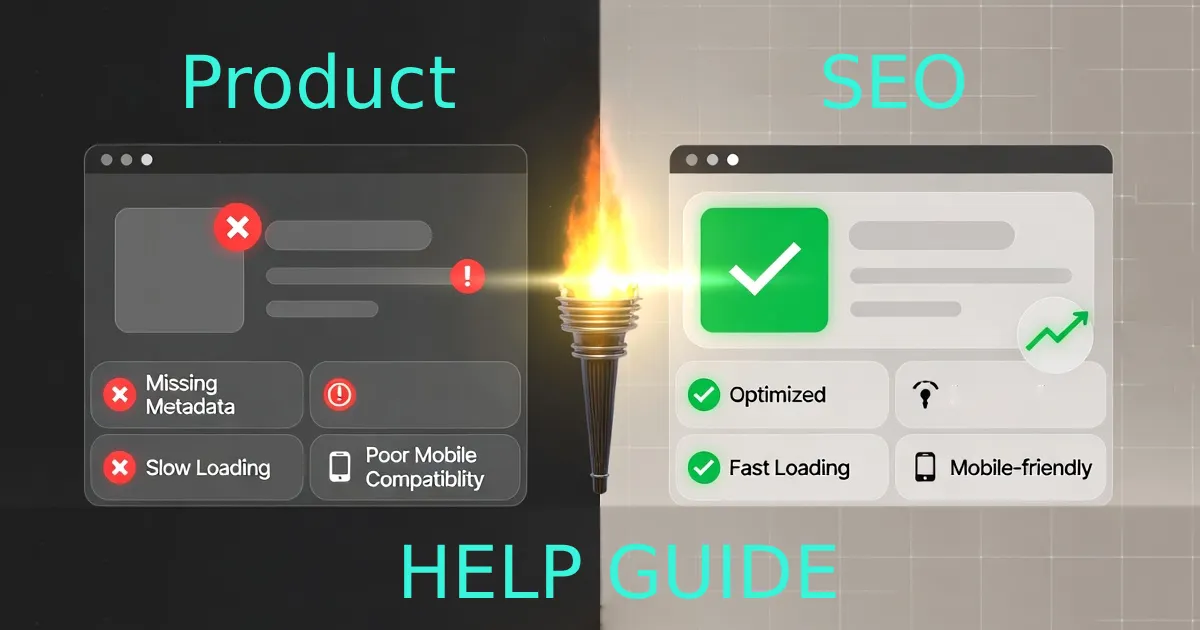
Product SEO Help Guide
The complete, up-to-date guide to mastering ecommerce product page SEO – explained using the exact logic inside Traffic Torch’s free 360° analysis tool
Want higher Google rankings, more organic clicks, and better conversions on your product pages? This 2026 guide walks you through every single metric that Traffic Torch measures - from title tag optimization to Product OR ProductGroup schema validation, image alt quality, and modern review-widget detection. You’ll learn:
- What each module actually evaluates (and its history in modern SEO).
- How Traffic Torch tests it - pulled directly from the live JavaScript logic.
- Why it drives rankings, UX, dwell time, CTR and revenue.
- Fast, prioritized fixes you can implement today.
Check your Product SEO Audit score in seconds.
Run an instant analysis on Traffic Torch.
Audit Your Product Page SEO →Frequently Asked Questions
What is a good Product Page Health Score on Traffic Torch? ▼
Aim for 85+ for “Excellent” status - you’ll usually see strong rankings and CTR in competitive niches. 70–84 = “Very Good” (solid but room to grow). 50–69 = “Needs Improvement” (fix technical + schema first). Below 50 = urgent red flags (noindex, no HTTPS, missing viewport, etc.).
How much does adding Product schema really help rankings? ▼
Directly? Not always a huge ranking boost. Indirectly? Massive. Rich snippets (stars, price, availability) increase CTR by 20–35% in most ecommerce SERP studies (2026 data). Higher CTR → more clicks → better engagement signals → improved rankings over time. It’s one of the fastest “win-win” fixes. Traffic Torch accepts both Product and ProductGroup schema, and rewards Merchant-listing fields like shippingDetails and hasMerchantReturnPolicy.
Why is mobile-friendliness still so important in 2026? ▼
Google has used mobile-first indexing since 2019–2021. In 2026, 55–70% of ecommerce traffic is mobile (depending on niche). Poor mobile UX = higher bounce, worse Core Web Vitals, lower rankings. A missing viewport meta, tap targets under 44px, or zoom-blocking directives like user-scalable=no or maximum-scale=1 can drop your entire page’s visibility on mobile SERPs. Traffic Torch checks all of these against mobile-first readiness.
How often should I re-audit my product pages? ▼
Best practice: audit after any major template change, CMS update, or migration. For live stores: re-scan top 20–50 revenue pages every 1–2 months, and spot-check new or low-performing pages weekly. Traffic Torch is free and instant - there’s no reason not to check regularly.
On-Page SEO
The foundational layer: What search engines and users first see and understand about your product.
🔍 What is On-Page SEO?
On-Page SEO evaluates the visible, crawlable elements on the product page itself. Title tag, meta description, headings, URL structure, and keyword prominence. These are the signals that tell Google and users exactly what the page is selling and why it matters.
History snapshot: On-page factors were king in the early 2000s (keyword stuffing worked). After Google’s Panda (2011) and Hummingbird (2013) updates, the focus shifted to natural language, user intent, and semantic relevance. Today in 2026, on-page is still critical. It must feel helpful and informative, not manipulative. Google also retired keyword-density as a metric years ago — modern SEO looks at prominence (where the keyword appears) and semantic coverage (how many related terms you cover), not raw repetition.
Traffic Torch measures five core on-page factors:
- Title Tag Optimization: Length, keyword placement, brand inclusion, truncation risk.
- Meta Description Relevance: Length, CTA, keyword presence, uniqueness.
- Heading Structure (H1–H6): Single H1, logical hierarchy, keyword usage.
- URL Structure: Clean, keyword-rich, hyphen-separated, no parameters.
- Keyword Prominence: Placement in title, H1, first 100 words, and one H2, plus semantic coverage of related product terms (features, materials, use-cases) and a modern keyword-stuffing check.
🛠️ How On-Page SEO is Tested in Traffic Torch
Traffic Torch parses the live DOM (via proxy-fetched rendered HTML) and runs precise checks against modern best-practice thresholds.
Title Tag Optimization
- Optimal length: 50–60 characters → 100 points.
- Deducts for under 30 or over 70 chars.
- Bonuses: primary keyword near start, brand at end, no all-caps or emoji spam.
- Penalty: risk of truncation in SERPs (checked via pixel-width estimation).
Meta Description Relevance
- Ideal: 100–170 characters.
- Bonus: main keyword present, includes CTA or benefit phrase.
- Penalty: duplicate across site, generic (“Shop now…”), or missing.
Heading Structure
- Exactly one H1 (usually product name).
- Logical flow: H2 → H3 (features, specs, FAQs).
- Keyword presence in H1 and top H2s.
URL Structure & Keyword Prominence
- URL: /category/product-name (hyphens, no ?id= or session IDs).
- Prominence checks: primary keyword in title, H1, first 100 words, and one H2 → full marks.
- Semantic coverage bonus: related product terms like features, materials, dimensions, warranty, shipping.
- Modern stuffing penalty: replaced the retired keyword-density metric. Detected only when the same phrase repeats unnaturally across short spans (not based on a raw percentage).
Module score = weighted average of the five factors (title & meta carry slightly more weight).
🎯 Why On-Page SEO Matters for Rankings & UX
Strong on-page = instant relevance signal. Google uses title, headings, and early content to decide if your page matches the search intent. Poor on-page = low CTR and high bounce. Both ranking killers in 2026.
- CTR lift: Optimized titles + metas → 20–35% higher click-through (Moz, Backlinko studies).
- Bounce rate drop: Clear H1 + keyword match → users stay longer.
- Topical authority: Natural keyword use in headings reinforces what the page is about.
- Mobile UX: Clean URLs and scannable structure = better experience on phones (50%+ of ecommerce traffic).
For official Google guidance on writing effective titles and meta descriptions, see Google's Title Link documentation .
Quick win example
Change “Product – MyStore” to “Santa Cruz Dreadnought Quilted Mahogany Acoustic Guitar | Warm Tone & Projection – MyStore” → better CTR + keyword relevance.
Technical SEO
The invisible foundation: Crawlability, security, mobile-first readiness and duplicate prevention.
🛡️ What is Technical SEO?
Technical SEO ensures search engines can find, crawl, render, and index your product page without barriers. It includes mobile-first readiness, security (HTTPS with no mixed content), canonical signals to prevent duplicate content penalties, proper robots directives, and URL patterns that suggest sitemap inclusion.
History snapshot: HTTPS became a ranking signal in 2014. Mobilegeddon (2015) penalized non-mobile-friendly pages. Mobile-first indexing rolled out fully by 2021. Google retired its standalone Mobile-Friendly Test in December 2023 — modern audits like Traffic Torch now check mobile-first readiness proxies (viewport, tap targets, zoom-blocking) that mirror what PageSpeed Insights and Chrome DevTools report. In 2026, technical health is non-negotiable — especially for ecommerce where one blocked or penalized page can mean lost revenue.
Traffic Torch checks five critical technical factors:
- Mobile-First Readiness: Viewport meta, tap target size, no zoom-blocking directives.
- HTTPS Implementation: Secure connection, valid certificate, plus a mixed-content scan for HTTP resources on HTTPS pages.
- Canonical Tags: Self-referencing and exact URL match (case-, protocol-, and trailing-slash-aware; tracking + variant params ignored).
- Meta Robots Directives: No accidental noindex/nofollow on live pages.
- Sitemap Inclusion Hints: Informational only. The DOM cannot verify sitemap membership, so this is a neutral check that surfaces a note in the fix panel.
🔧 How Technical SEO is Tested on Traffic Torch
Traffic Torch fetches the fully rendered page (via secure proxy) and inspects both headers and DOM for strict compliance.
Mobile-First Readiness
- Presence of
<meta name="viewport" content="width=device-width, initial-scale=1">. - Penalises
user-scalable=noandmaximum-scale=1— these block zoom and hurt accessibility + rankings. - Detects inline-styled tap targets (buttons, links) under 44px that would fail mobile-first usability.
- Because Google retired the standalone Mobile-Friendly Test in 2023, this module mirrors what PageSpeed Insights and Chrome DevTools → Device Toolbar report — use those to verify fixes.
HTTPS Implementation + Mixed Content Scan
- Page served over https://.
- For pasted-HTML audits the score is neutral (60) — the tool cannot verify a scheme from raw code.
- Scans the DOM for
img[src^="http://"],script[src^="http://"],link[href^="http://"],iframe[src^="http://"],video[src^="http://"],audio[src^="http://"]. Each mixed-content hit reduces the score.
Canonical Tags
- Exactly one
<link rel="canonical">tag. - Canonical href matches the live URL 100% (protocol, domain, path, trailing-slash, case-sensitive).
- Tracking parameters (
utm_*, fbclid, gclid, _ga, _gl) and commerce-specific params (variant, color, size, sku, pid) are ignored during the match — so Shopify/Amazon variant URLs still pass cleanly.
Meta Robots & Sitemap Hints
- Flags
<meta name="robots" content="noindex">ornofollowon live pages. - Sitemap hints are informational only — the DOM cannot verify whether a URL is actually in your sitemap. The module always scores this neutral so it never drags your health score down.
- Confirm sitemap membership manually via your CMS sitemap generator, or by submitting the URL in Google Search Console → Sitemaps.
Module score = weighted average (mobile-first readiness carries 35%, HTTPS 30%, canonical 20%, robots 15%).
📈 Why Technical SEO Matters for Rankings & UX
Technical issues are silent traffic killers. A page that can’t be crawled or indexed never ranks. No matter how great the content is.
- Indexing & crawl budget: Clean technical setup = more pages indexed faster.
- Mobile rankings: Since mobile-first indexing, poor mobile = severe ranking drop.
- Trust & conversions: HTTPS reduces cart abandonment (studies show ~5–10% lift).
- Duplicate content protection: Proper canonicals prevent self-competition penalties.
Google’s official requirements for mobile-first indexing and HTTPS are covered in Mobile-first Indexing best practices and the Web.dev HTTPS guide . For mobile debugging, use PageSpeed Insights or Chrome DevTools → Device Toolbar.
Quick win example
Fix missing viewport meta + force HTTPS redirect + clear mixed content → often jumps mobile usability score from red to green and improves Core Web Vitals indirectly.
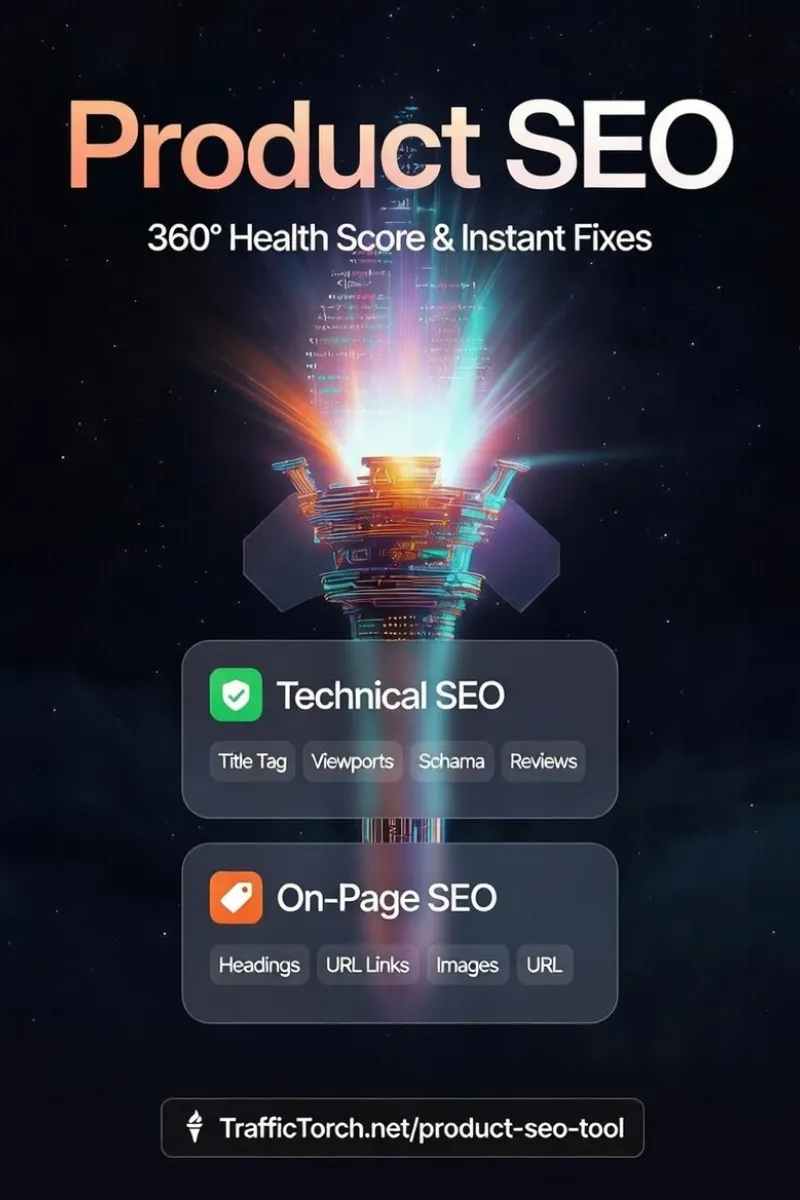
Get your Product Page SEO Analysis score.
Run an instant SEO analysis on Traffic Torch.
Online Product SEO Audit Tool →Content & Media
The engagement engine: Rich, accessible, trust-building elements that keep users reading and buying.
🗝️ What is Content & Media?
Content & Media evaluates how rich, helpful, and user-friendly the on-page experience is. From detailed product descriptions and optimized images to videos, reviews, contextual internal links, and breadcrumb navigation. These elements directly influence dwell time, trust signals, and topical depth.
History snapshot: Post-Penguin (2012) and Helpful Content updates (2022–2025), thin or duplicate content gets deprioritized. In 2026, Google heavily weighs user engagement signals (dwell time, scroll depth, pogo-sticking) and E-E-A-T (Experience, Expertise, Authoritativeness, Trustworthiness). Rich media + UGC = stronger trust and ranking potential. Modern review-widget ecosystems (Okendo, Yotpo, Judge.me, Loox, TestFreaks, Trustpilot, Bazaarvoice) also render their content via JavaScript — so detection needs to look beyond static DOM markers.
Traffic Torch assesses six key content & media factors:
- Product Description Quality: Length, uniqueness, structure, benefit focus.
- Image Optimization: Alt text quality (meaningful vs decorative), lazy loading, responsive srcset, file-size hints.
- Video Embed Quality: Captions via native tracks, embed params, or nearby transcript sections.
- User-Generated Content (UGC): Reviews, star rating, and review count detected via modern widget markers or AggregateRating schema.
- Internal Linking: Contextual in-body links only (nav, header, footer, and external links excluded).
- Breadcrumb Navigation: DOM breadcrumb markers or BreadcrumbList JSON-LD.
📸 How Content & Media is Tested in Traffic Torch
Traffic Torch deeply inspects the DOM and classifies elements using smart heuristics pulled straight from the live JavaScript logic.
Product Description Quality
- Word count: 300+ ideal (400–800 for competitive niches) → higher score.
- Structure bonus: bullets, subheadings (H2/H3), tables.
- Penalty: under 100 words, duplicate boilerplate, obvious stuffing.
- Benefit-focused language detected via keyword patterns.
Image Optimization
- Classifies images: decorative (explicit
alt="", icons, spacers, logos, role=presentation) vs meaningful. - Alt text scoring: descriptive & keyword-rich = high points; missing attribute or filename-only = penalties.
- Checks:
loading="lazy", srcset/sizes present, file-size hints (under 100 KB ideal).
Video Embed Quality
- Detection of native
<video>elements, YouTube, Vimeo, and youtu.be iframes. - Caption coverage checked across three sources:
<track kind="subtitles">, YouTube/Vimeo embed params (cc_load_policy=1,cc_lang_pref), and nearby transcript sections. - Pages without video score neutral — no false failures for text-and-image-only products.
UGC, Internal Links & Breadcrumbs
- UGC: modern widget markers including
.okeReviews,[data-oke-container],#testfreaks-reviews, Yotpo, Judge.me, Loox, Stamped, Trustpilot, Bazaarvoice, plus AggregateRating in schema. - Internal links: contextual in-body only. Nav, header, footer, external, anchor-only (
#),mailto:, andtel:links are excluded. - Breadcrumbs: DOM markers (.breadcrumbs, .break-crumb, .woocommerce-breadcrumb, [itemprop="breadcrumb"], etc.) or BreadcrumbList JSON-LD.
Module score = weighted average (description & images carry the most weight due to direct UX/ranking impact).
⏱️ Why Content & Media Matters for Rankings & UX
Rich content = longer dwell time = stronger ranking signal. Google’s 2024–2026 Helpful Content & Core Web Vitals updates reward pages that keep users engaged and reduce pogo-sticking.
- Dwell time & engagement: Detailed descriptions + visuals → users stay 2–4× longer.
- Trust & conversions: Reviews/UGC increase purchase intent by 4× (multiple studies).
- Image SEO & accessibility: Good alts improve image search traffic + screen-reader UX.
- Site architecture: Contextual internal links & breadcrumbs distribute authority and help navigation.
Learn Google’s latest recommendations for helpful, people-first content (including rich media and user engagement signals) in the official Creating helpful, reliable, people-first content guide .
Quick win example
Add a 400-word benefit-focused description with bullets + 5 descriptive image alts + 3 contextual internal links + enable video captions → often lifts on-page time and topical relevance score dramatically.
E-Commerce Signals
The rich results & conversion layer: Structured data, pricing, reviews, variants, and social sharing that power SERP visibility and trust.
🛍️ What is E-Commerce Signals?
E-Commerce Signals focus on structured data (schema.org), pricing/availability markup, review aggregation, variant handling, and social sharing tags. These elements enable rich snippets (stars, price, images in SERPs), prevent duplicate content issues, and boost click-through rates and conversions.
History snapshot: Schema.org launched in 2011; Google started showing rich results (price, stars, availability) shortly after. Merchant Center integration and variant handling became critical with mobile shopping growth. In 2026, complete Product OR ProductGroup schema — plus Merchant-listing fields like shippingDetails and hasMerchantReturnPolicy — is almost mandatory for competitive ecommerce SERPs. Missing it often means no rich-snippet advantage. Shopify's newer variant pattern (ProductGroup with hasVariant array) is now fully supported.
Traffic Torch evaluates five essential e-commerce factors:
- Product Schema Markup: Valid JSON-LD using
ProductORProductGroupwith required fields (name, image, offers, brand, sku/mpn), plus Merchant-listing fields (shippingDetails, hasMerchantReturnPolicy, gtin, itemCondition, priceValidUntil) for full credit. - Price & Availability Markup: Best-offer scoring — the tool picks the strongest offer rather than summing them, so multi-variant pages don’t inflate the score.
- Review Schema & Aggregation: AggregateRating at group level or inside the first variant, with ratingValue and reviewCount.
- Variant Handling: Single-page selectors or proper canonicals on variant URLs. Genuine single-SKU products get a neutral pass (not a failure).
- Social Sharing Integration: Open Graph tags (og:title, og:description, og:image 1200×630+, og:url) and optional Twitter Cards.
📊 How E-Commerce Signals is Tested in Traffic Torch
Traffic Torch extracts and parses all JSON-LD scripts, normalises ProductGroup into a Product-like shape by merging from the first variant, validates against schema.org specs, and checks social meta tags.
Product / ProductGroup Schema Markup
- Finds
@type: "Product"OR@type: "ProductGroup"in JSON-LD scripts, including@typearrays. - ProductGroup schemas are merged with their first variant (
hasVariant) so image, offers, sku, gtin, and aggregateRating inherit cleanly. - Required fields checked: name, image (array preferred), description, brand.name, sku or mpn, offers.
- Merchant-listing bonuses: shippingDetails, hasMerchantReturnPolicy, gtin, itemCondition, priceValidUntil.
Price & Availability + Review Schema
- offers: price (string number), priceCurrency (ISO 4217), availability (full schema.org URL like https://schema.org/InStock), itemCondition, priceValidUntil.
- Best-offer scoring: checks every offer and keeps the highest-scoring one — prevents multi-variant pages from inflating past 100.
- AggregateRating: ratingValue (1.0–5.0 decimal), reviewCount or ratingCount (integer), checked at Product level or the first variant for ProductGroup schemas.
- Bonus for 2–5 individual Review objects.
Variant Handling & Social Tags
- Variants: prefers single URL with JS switching; separate URLs must have self-canonical. Detected via DOM selectors (.swatch, .product-option, [data-variant], etc.).
- Genuine single-SKU products (no variant pickers, single offer) score neutral — the tool no longer fails them for not having variants.
- ProductGroup with multiple variants gets a pass automatically via the schema.
- Open Graph: og:title, og:description, og:image (1200×630+), og:url present and matching the canonical.
Module score = weighted average (Product schema completeness and offers/review markup carry the most weight due to rich-result eligibility).
⭐ Why E-Commerce Signals Matters for Rankings & UX?
Rich snippets = massive CTR advantage. Pages with stars, price, and availability in search results often see 20–35% higher click-through rates (2026 ecommerce SERP studies).
- Visibility boost: Schema enables price, stars, images, stock status in SERPs.
- Trust & conversions: Visible reviews + accurate pricing reduce hesitation → higher add-to-cart rates.
- Duplicate protection: Proper variant canonicals avoid self-competition penalties.
- Social amplification: Strong OG tags = better-looking shares on Facebook, LinkedIn, X → more referral traffic.
Full technical requirements and examples for Product structured data (including rich-results eligibility and the modern Merchant-listing fields) are documented in Google’s official Product structured data guide .
Quick win example
Add complete Product OR ProductGroup schema with offers, AggregateRating, shippingDetails, and hasMerchantReturnPolicy → frequently turns a plain blue link into a rich result with stars and price, lifting CTR significantly in one update.

Find your Product Page SEO score.
Run an instant SEO audit on Traffic Torch.
Test Your E-Commerce SEO Signals →Master Product SEO in 2026
Product page SEO is no longer about tricks, it’s about delivering fast, mobile-first, trustworthy, rich experiences that match searcher intent and keep buyers engaged.
Traffic Torch gives you the complete 360° picture in seconds: on-page foundations, technical reliability, content depth, and e-commerce rich-result power. Fix the lowest-hanging fruit first (usually schema + title/meta + mobile-first readiness + description length), then layer in reviews, contextual internal links, and image alts for compounding gains.
Every fix you make moves the needle. Better rankings, higher CTR, longer dwell time, more trust, and ultimately more revenue. The tools and knowledge are free. The only question is: which product page will you optimize first?